


Key Takeaways
- Cold slows every battery. That's why smartwatch battery cold weather performance drops so sharply on a ski day, even when nothing is wrong with the watch.
- A smartwatch dying at "40%" is the watch protecting its battery, and most of that charge comes back once it warms up.
- Most smartwatches won't charge below freezing, so a cold watch has to thaw before it'll take a charge.
- Quartz watches have batteries too, but they run for years on a tiny current and never need charging, so the cold makes little practical difference.
- Tritium needs no battery at all. Cold doesn't touch the glow.
Why Does My Smartwatch Die in the Cold?
Cold slows the chemical reactions inside a battery. Your smartwatch's rechargeable battery can't deliver power as easily, so it drains faster and can shut down early. The charge hasn't gone. It's locked away until the battery warms up.
If you've ever asked why does my smartwatch die in the cold, that's the short answer. It isn't a fault. It's how batteries behave.
We've built watches for cold, dark and wet conditions since 2003, and this question matters to us because our quartz watches run on batteries too. Here's what cold does to your smartwatch, what it does to ours, and why tritium sits outside the problem entirely.
What Cold Does to a Smartwatch Battery
Every battery works the same way at heart. A chemical reaction inside it releases energy, and that reaction needs warmth to run at full speed.
Cool it down and everything slows. Less power comes out when the watch asks for it, and the battery's internal resistance rises, a bit like pushing water through a half-frozen pipe.
A smartwatch is hit harder than most kit. It's small and it sits out in the cold on your wrist. It also asks a lot of a tiny battery: a bright screen, sensors, Bluetooth and often GPS, all day long.
Put that on a chairlift in January and you've found the root of most smartwatch battery cold weather problems.
How Much Smartwatch Battery Do You Lose in Cold Weather?
Often more than you'd expect. Battery University, a long-running battery reference, puts most batteries at around 50% of their normal performance at -20°C. A 2025 lab test on a lithium iron phosphate battery module recorded losses of about 15% at -10°C and 35% at -20°C. Smartwatch cells use a different chemistry, so treat those figures as a guide.
Exact numbers depend on the battery and how hard it's working. Lithium battery cold performance always heads the same way, though. Colder means less.
Now think about where people ski. January mornings at altitude in the Alps often drop well below freezing. In Scotland, the Cairngorms spend much of the winter below freezing.
Right where a smartwatch battery starts to struggle.
The 40% Shutdown Explained
This is the one that catches people out.
A smartwatch works out how much charge is left by reading the battery's voltage. In the cold, that voltage dips every time the watch works hard. The watch sees the dip, assumes the battery is nearly empty, and shuts down to protect it.
Picture a day above Val d'Isère. Your watch dies at lunch showing 40%. Back in the chalet an hour later, it switches on showing roughly the same figure.
The charge was there all along. The cold stopped the watch getting at it.
Nothing has failed. The watch is protecting itself. Little comfort when you're trying to meet your group for the final run of the day.
Why You Can't Charge It on the Mountain
The obvious fix is to plug it in. On a frozen mountain, that's off the table.
Charging a rechargeable lithium battery in those conditions can cause permanent damage. Battery University's charging guidance is clear: don't charge them below 0°C at all. Most smartwatches are built to limit or block charging when they're too cold.
A frozen smartwatch has to warm up first. Then it charges. Then you head back out.
Power banks help, up to a point. A power bank in your jacket pocket is sitting in the same cold, and its battery loses capacity too. Mountain restaurants and gondola stations can't be relied on for a spare socket either.
Why a GPS Watch Drains Faster in the Cold
GPS is the biggest drain on any smartwatch. Even in a warm room, tracking your position eats through the battery.
On the mountain, four things stack up at once:
- The cold cuts how much charge the battery can give.
- Voltage dips under load, pushing the watch towards an early shutdown.
- GPS tracking runs for hours to log every run.
- No charging until the watch has warmed up indoors.
Any one of these is manageable. Put all four together over a full ski day and a GPS watch can run flat hours before you expected. Longer days and colder weather push it further, and a trip with no charging access makes it worse again. Cold can also make wrist heart rate readings less reliable, as circulation to your hands drops.
How to Keep a Smartwatch Going in the Cold
If you're sticking with a smartwatch for the slopes, a few habits make a real difference. The simplest smartwatch battery cold weather fix is warmth.
- Wear it under your cuff. Your body heat keeps the battery closer to its comfort zone.
- Charge it fully indoors the night before, so you start the day at 100%.
- Use GPS only when you need it. Tracking every run is the fastest way to drain a cold battery.
- Dim the screen and switch off the always-on display.
- Keep your power bank in an inside pocket, not an outer one.
- Warm it up before charging. Plugging in a frozen watch risks permanent damage.
None of this changes the chemistry. It buys you time. The battery rating on the box was tested at room temperature, so treat it as a best case in the mountains.
Doesn't a Quartz Watch Have a Battery Too?
Yes. It's a fair question, because our MX10, Hawk, Alpha and Alpha Z ranges all run on Swiss Ronda quartz movements with a small battery inside. Our Atlas is the exception: a Swiss automatic, wound by the movement of your wrist, with nothing to replace or recharge.
Cold slows a quartz battery too. The difference is the job it's doing.
A quartz movement drives the hands. No screen, no sensors, no GPS. It draws a trickle of current, so little that the battery lasts years rather than days. Our MX10 runs for 4 to 5 years on a single cell. The Hawk and Alpha use the Ronda 715Li, with a battery rated for 10 years.
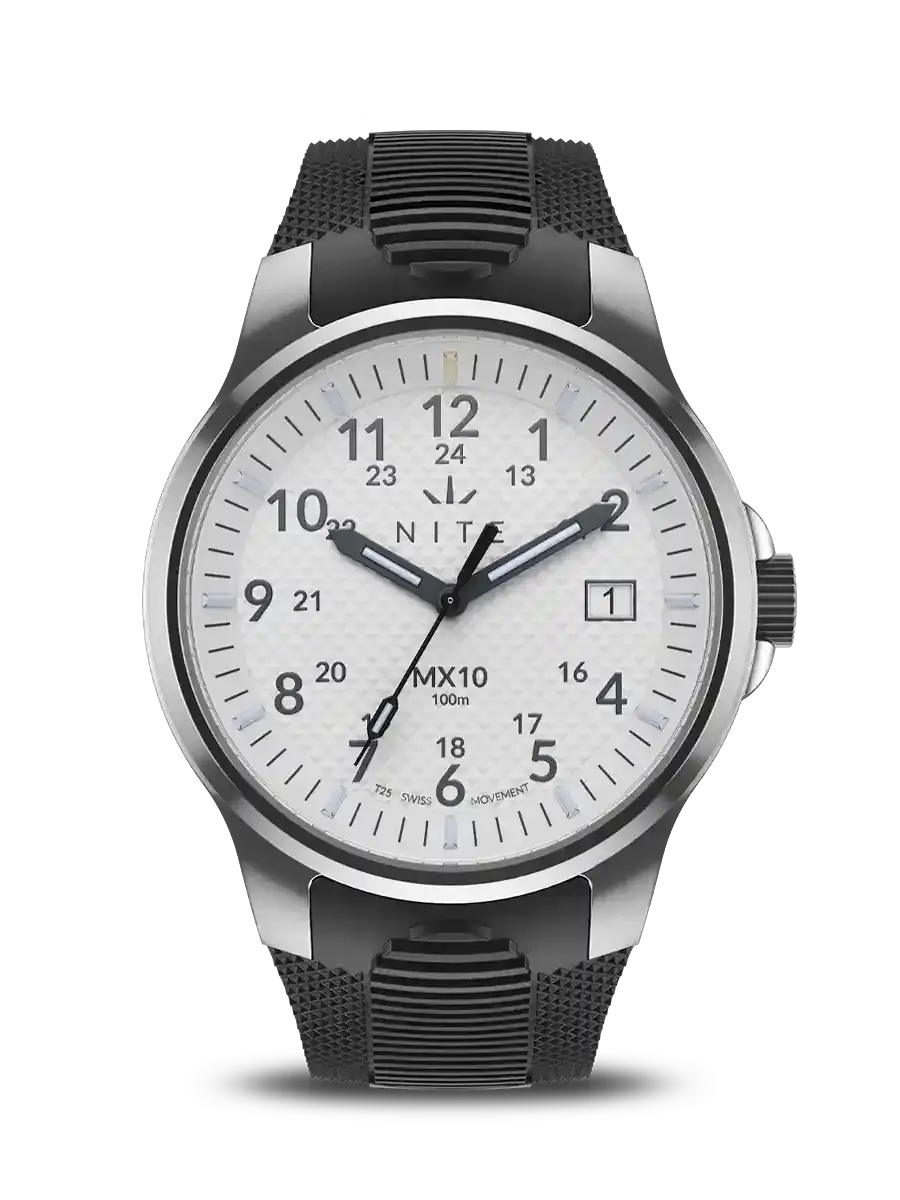
The MX10 Polar, running a Swiss Ronda 715 with a 4 to 5 year battery.
When a battery has years in reserve and only supplies a fraction of a smartwatch's power, a cold day barely registers. It won't run flat over a ski week because of the temperature. And it never needs charging, so there's no cable and no waiting for it to thaw.
Our Swiss quartz movement guide covers how these movements differ.
Tritium: Light That Doesn't Need a Battery
Here's where the cold stops mattering altogether.
Every NITE watch is lit by tritium, a gas sealed inside small glass tubes that glows on its own. No power is borrowed from the watch battery, and unlike luminous paint, which fades after dark, there's no charging in sunlight. The glow runs 24 hours a day.
That's why we fit tritium to every watch we make: the light never depends on a battery. It's the same approach that put the MX10 on the wrists of UK Special Forces.
That glow comes from radioactive decay, not a chemical reaction. Cold doesn't change the rate of radioactive decay in any meaningful way. Not at -5°C on a winter walk. Not at -20°C on an Alpine summit.
The dial you read in your kitchen is the one you read on the mountain. No drop-off, no shutdown, nothing to recover when you're back inside.
Tritium does fade slowly over many years, which our tritium half-life guide explains. Cold doesn't speed that up. For how the glow works, see our guide to how tritium glows.
What Tritium Won't Do
Tritium has limits, and you should know them before you buy.
It lets you read the time in the dark, and in winter that counts: short days, early starts and long walks back after last light. What it won't do is track your runs, measure your heart rate or show you a map. It doesn't power any electronics.
That's a narrower claim than "better at everything", and it's meant to be. A tritium watch doesn't replace a GPS device. For winter sports watch reliability, it offers something a smartwatch can't guarantee in the cold. A dial you can read at any hour, on any day of the trip, with no charge to think about.
Smartwatch or Tritium Watch for Winter?
Smartwatches aren't useless in winter. If you want piste tracking, heart rate and training data, a GPS watch does a real job. Charged well and used selectively in moderate cold, one will often last a ski day.
The trouble comes with longer days, harder cold, constant GPS and trips with no charging.
The choice comes down to what you need the watch for. Want data and happy to manage charging? A GPS watch makes sense. Want a watch for winter sports, no battery drain, no cables and no thinking about it on day seven? An analogue quartz watch with tritium is the better fit.
None of this makes a smartwatch worse: the two are simply built for different jobs.
Which NITE Watch Suits Cold Conditions?
Two watches in our range suit winter well.
The Hawk Polar is our lightweight option. A reinforced polycarbonate case keeps it to 70g, so it won't drag on your wrist through a long day. It pairs that with a screw-down crown, 200m water resistance and a 10-year battery.

The Hawk Polar, rated to 200m with sapphire crystal.
The MX10 Polar is our original field watch in ice blue and orange tritium. Its 39mm 316L steel case sits low enough to slide under a jacket cuff.
For cold weather watch reliability closer to home, read our guide to watches for UK weather. Our tritium watches buyer's guide covers the bigger picture, or browse the full Hawk and MX10 collections.
Frequently Asked Questions
Why do batteries drain faster in cold weather? Low temperatures slow the reactions that release a battery's energy and push up its internal resistance. The device gets less power, runs down sooner and may switch off early.
Why does my smartwatch battery drain so fast in the cold? A screen, sensors and GPS all draw on a battery the cold has already weakened. Most of the charge returns once the watch warms up.
Does cold weather affect a quartz watch battery? Yes, a little. Quartz movements use so little power that you won't notice on a ski trip.
Is tritium affected by cold? No. Tritium's decay rate doesn't change with temperature, so the glow on a frozen summit matches the glow indoors.
How cold is too cold for a smartwatch? Many manufacturers advise keeping smartwatches above freezing. Limits vary by model, so check your own watch's guidance.
Can I charge my smartwatch in the cold? It's best not to. Charging below 0°C risks permanent battery damage, and most smartwatches won't allow it until they've warmed up.


